Text Search & Re-ID
Trackflow separates two problems that look similar on the surface but need different models:
- Text search (
--vlm,--query,trackflow search): Matches a person's crop against a plain-English description such as "person in a red jacket carrying a backpack". - Identity matching (
--reid osnet,--reid-merge): Decides whether two crops belong to the same individual across occlusions or room exits.
Vision-language models (CLIP, SigLIP, SigLIP 2, EmbeddingGemma 2) are trained for image-to-text alignment, not person identity — on vtest.avi, two different people scored 0.83 cosine similarity on average versus 0.86 for the same person. Trackflow therefore never uses VLMs for track identity; identity always uses a dedicated Re-ID encoder (osnet).
Live text search (--query)
Highlight tracks matching a text prompt during a run:
When --query is passed without --vlm, Trackflow defaults to --vlm clip. Every observation in tracks.parquet and tracks.jsonl gets a query_score (cosine similarity) and query_match boolean.
Override the match threshold with --query-threshold if needed. Built-in defaults are calibrated per VLM:
--vlm |
Default --query-threshold |
Runtime |
|---|---|---|
clip |
0.27 |
Pure ONNX (INT8) |
siglip |
0.08 |
Pure ONNX (INT8) |
siglip2 |
0.09 |
Pure ONNX (INT8) |
embeddinggemma |
0.71 |
PyTorch ([transformers] extra) |
Offline search over saved Track Cards (trackflow search)
To index every track once and run unlimited queries later without re-running detection, pass --vlm during trackflow run:
# 1. Track once and save Track Card embeddings (no video render needed)
trackflow run lobby_2h.mp4 --vlm siglip2 --no-video

# 2. Search the saved run in milliseconds with any number of queries
trackflow search runs/run-1 "person carrying a suitcase"
trackflow search runs/run-1 "woman in yellow coat" --top-k 5 --json
Trackflow saves each track's highest-confidence crop and VLM embedding into track_cards.json (plus thumbnail images unless --anonymize is active). You can also run natural-language queries interactively inside trackflow inspect.
Choosing a VLM
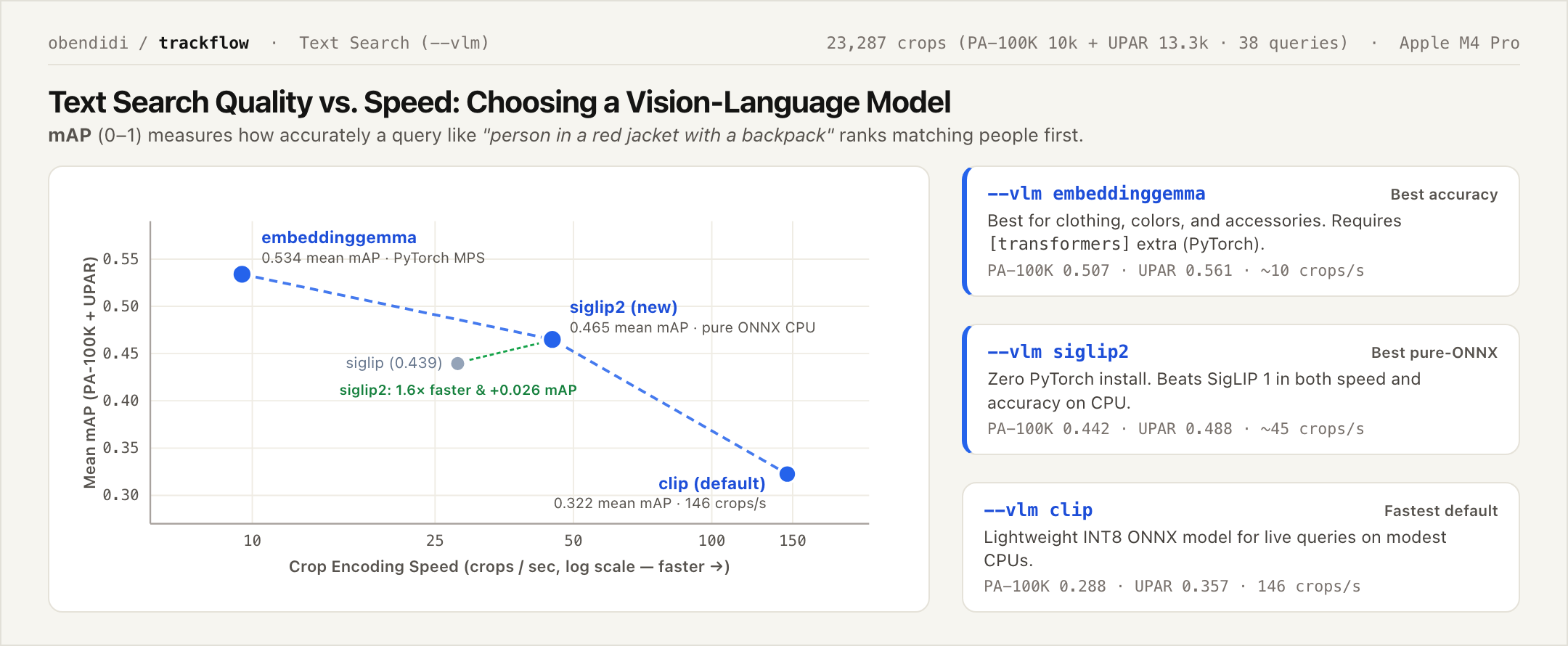
Evaluated across 23,287 labeled pedestrian crops from PA-100K (10,000 crops, 18 clothing/accessory queries) and UPAR (13,287 crops, 20 color/attribute queries) via scripts/eval_text_search.py:
--vlm |
PA-100K mAP | UPAR mAP | Throughput | Dependency |
|---|---|---|---|---|
embeddinggemma |
0.507 | 0.561 | ~10 crops/s (M4 Pro MPS) | trackflow-python[transformers] |
siglip2 |
0.442 | 0.488 | ~45 crops/s (CPU ONNX INT8) | Core (pure ONNX) |
siglip |
0.420 | 0.459 | ~28 crops/s (CPU ONNX INT8) | Core (pure ONNX) |
clip (default) |
0.288 | 0.357 | 146 crops/s (CPU ONNX INT8) | Core (pure ONNX) |
- Use
siglip2as the default upgrade when you want noticeably better clothing and attribute accuracy without installing PyTorch. - Use
embeddinggemmawhen search accuracy matters more than throughput and you already have PyTorch/MPS/CUDA. - Use
clipfor maximum speed on CPU or quick screening.
Exporting prompt windows for SAM 3 or VLMs
Turn top text-search hits into a structured JSON manifest (trackflow.prompts.v1) with padded time windows and normalized [0, 1] boxes/points:
trackflow search runs/run-1 "person carrying a red backpack" \
  --top-k 5 --pad-s 1.0 --export-prompts prompts.json
This lets Trackflow scan hours of footage locally and hand only the few relevant 5-second clips to a heavy segmentation model. See the SAM 3 Handoff guide for a full runnable example.
Cross-exit re-identification (--reid-merge)
If a person walks out of view for longer than the tracker's short occlusion buffer and returns later, --reid-merge can assign their earlier track_id:
How Trackflow limits false merges:
- Disjoint time windows: Only compares against tracks that ended before the new track started, and stayed absent longer than the tracker's internal recovery window.
- Unambiguous winner: Merges only when one prior track exceeds the similarity threshold with a clear margin over the runner-up; look-alikes remain separate.
- Opt-in by default: Low-resolution or dark footage can still produce false merges, so
--reid-mergeis off unless explicitly enabled.
Merged tracks are counted in summary.json (reid_merges).