Benchmarks
All measurements below are reproducible from scripts in the repository. Numbers reflect real runs on standard datasets and public hardware, not cherry-picked synthetic clips.
Tracker accuracy across 4 official MOT datasets
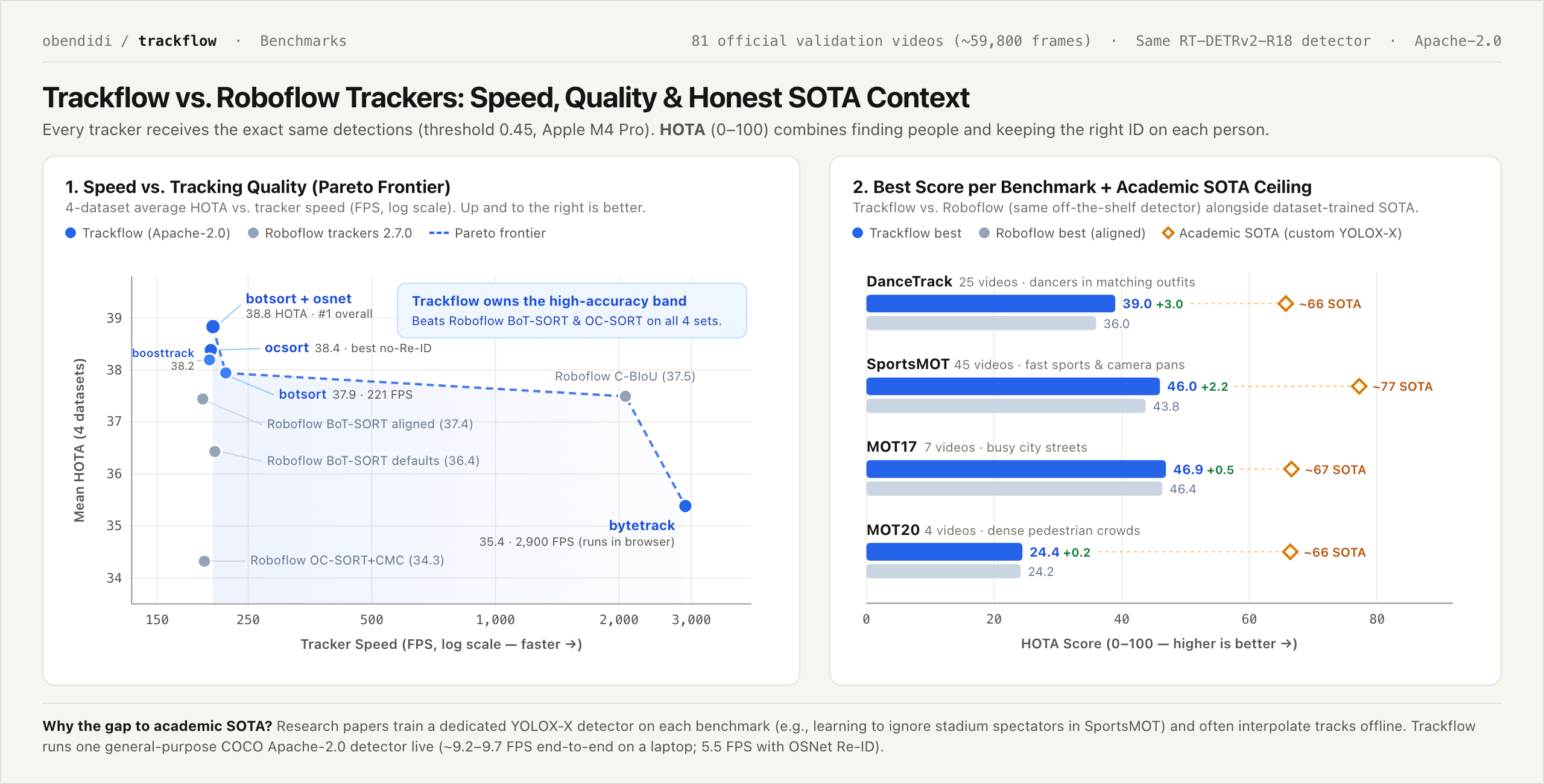
Evaluated across 81 videos (~59,800 frames) using identical detections from Trackflow's default Apache-2.0 detector (rtdetr-v2-r18, --threshold 0.45, Apple M4 Pro) so every row isolates the tracking algorithm alone:
| Tracker | DanceTrack (25) | SportsMOT (45) | MOT17 (7) | MOT20 (4) | Mean HOTA | Total ID switches | Tracker FPS | End-to-End FPS |
|---|---|---|---|---|---|---|---|---|
nltrack --reid osnet |
47.1 | 50.2 | 48.1 | 26.1 | 42.9 | 5,193 | 133 | 5.4 |
nltrack (no Re-ID) |
39.0 | 45.6 | 47.3 | 26.3 | 39.6 | 6,209 | 143 | 9.0 |
botsort --reid osnet |
39.0 | 45.0 | 46.9 | 24.4 | 38.8 | 6,435 | 205 | 5.5 |
ocsort (no Re-ID) |
37.9 | 46.0 | 46.3 | 23.3 | 38.4 | 5,501 | 203 | 9.2 |
boosttrack (no Re-ID) |
37.5 | 44.4 | 46.9 | 24.0 | 38.2 | 5,549 | 201 | 9.2 |
botsort (no Re-ID) |
36.7 | 44.3 | 46.5 | 24.3 | 37.9 | 6,475 | 221 | 9.3 |
bytetrack (also in browser) |
33.1 | 39.8 | 45.1 | 23.5 | 35.4 | 7,038 | 2,900 | 9.7 |
Roboflow cbiou (0.45/0.50) |
36.0 | 43.4 | 46.4 | 24.2 | 37.5 | 7,533 | 2,072 | 9.6 |
Roboflow botsort (0.45/0.50) |
35.9 | 43.6 | 46.3 | 24.0 | 37.4 | 6,922 | 194 | 9.2 |
Roboflow ocsort+cmc (0.45) |
33.4 | 43.8 | 44.2 | 15.9 | 34.3 | 8,057 | 196 | 9.2 |
Roboflow botsort (defaults 0.60/0.70) |
39.6 | 50.0 | 42.6 | 13.6 | 36.4 | 4,349 | 207 | 9.2 |
How to read these numbers
- HOTA (0–100, higher is better): Balances detection accuracy and association accuracy equally.
- ID switches (lower is better): Count of mid-video ID swaps or resets.
- Tracker FPS vs End-to-End FPS: Tracker FPS measures association alone; End-to-End FPS includes per-frame detection (and
osnetRe-ID crops when enabled) on a laptop. - Datasets: DanceTrack (25 clips of dancers in identical outfits), SportsMOT (45 fast-panning sports clips), MOT17 (7 busy street scenes), MOT20 (4 dense pedestrian crowds, second halves).
- Why academic SOTA is higher (~66–77 HOTA): Leaderboard papers train a specialist detector (usually YOLOX-X) directly on each dataset — learning, for instance, to ignore crowd spectators in SportsMOT — and often interpolate tracks offline after the video ends. Trackflow runs one off-the-shelf, general-purpose Apache-2.0 COCO detector live, frame by frame. Pass
--threshold 0.6on sports broadcasts for spectator filtering comparable to Roboflow's0.60/0.70default.
Reproduce with scripts/eval_benchmarks.py (controls run trackers==2.7.0, scored via trackers eval, matching TrackEval).
Detector accuracy on MOT17 (with ByteTrack)
| Preset | HOTA | IDF1 | MOTA | License |
|---|---|---|---|---|
dfine-m |
46.5 | 55.1 | 39.2 | Apache-2.0 |
rtdetr-v2-r18 (default) |
45.1 | 53.9 | 39.8 | Apache-2.0 |
rfdetr-large |
44.3 | 51.1 | 35.9 | Apache-2.0 ([transformers]) |
rfdetr-medium |
42.9 | 49.7 | 34.8 | Apache-2.0 |
yolo26n |
37.4 | 41.4 | 27.9 | AGPL-3.0 |
rfdetr-nano |
36.5 | 40.5 | 28.2 | Apache-2.0 |
dfine-m scores highest (46.5 HOTA with ByteTrack, 46.9 with BoT-SORT), while rtdetr-v2-r18 stays the faster default (10.0 vs 7.3 FPS on M4 Pro CoreML).
Natural-language track search (PA-100K & UPAR)
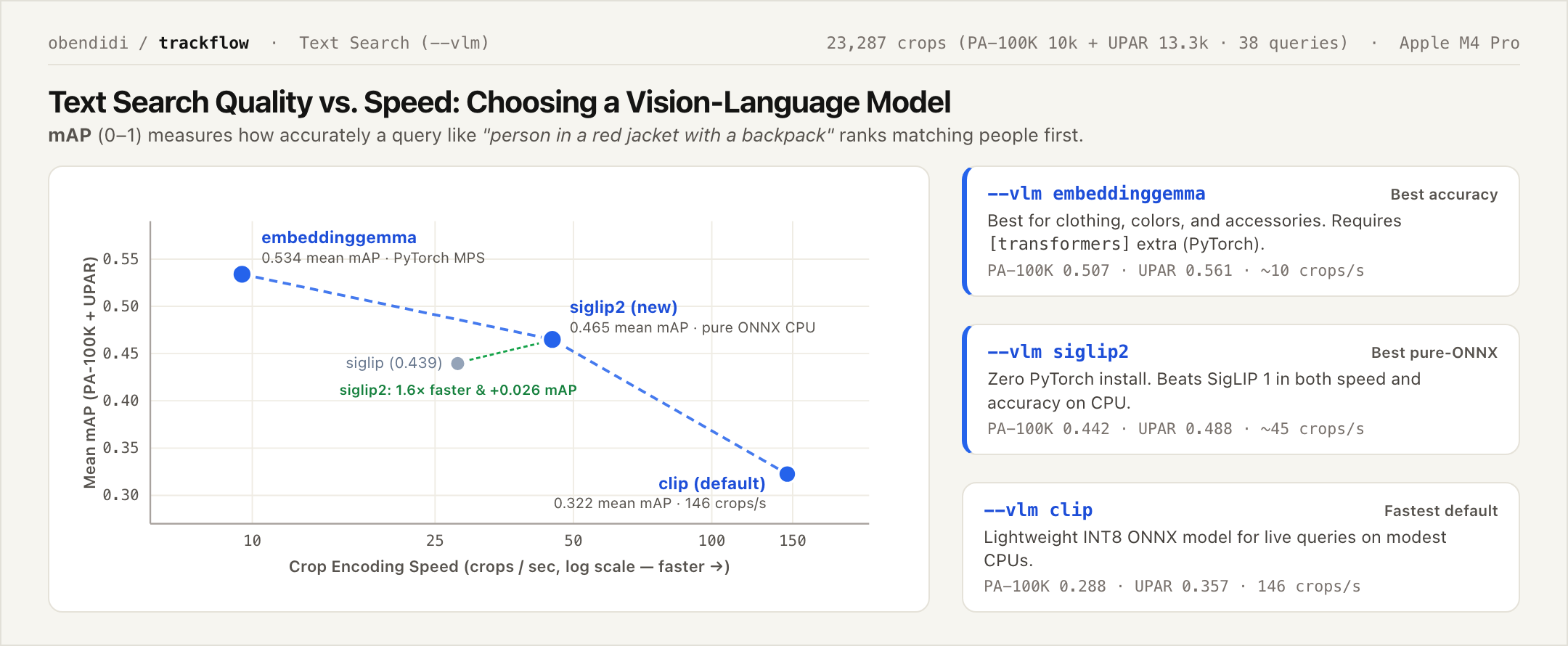
Measured across 23,287 labeled pedestrian crops (10,000 PA-100K across 18 clothing/accessory queries; 13,287 UPAR across 20 color/attribute queries) with scripts/eval_text_search.py:
--vlm |
PA-100K mAP | UPAR mAP | Speed | Notes |
|---|---|---|---|---|
embeddinggemma |
0.507 | 0.561 | ~10 crops/s (M4 Pro MPS) | PyTorch ([transformers] extra) |
siglip2 |
0.442 | 0.488 | ~45 crops/s (CPU ONNX INT8) | Best pure-ONNX preset |
siglip |
0.420 | 0.459 | ~28 crops/s (CPU ONNX INT8) | Pure ONNX INT8 |
clip (default) |
0.288 | 0.357 | 146 crops/s (CPU ONNX INT8) | Fastest screening option |
GPU throughput & parity (NVIDIA T4 & L4)
NVIDIA Tesla T4 (CUDA FP32 vs TensorRT 10 FP16)
Measured inside an isolated venv with system CUDA and TensorRT library paths stripped (proving zero-config pip library preloading) on vtest.avi (5-frame box IoU parity against CPU + 40-frame steady-state inference timing):
| Model | CUDA FP32 | TensorRT FP16 (warm) | Speedup vs CUDA | Mean IoU vs CPU | Cold build → Warm load |
|---|---|---|---|---|---|
rtdetr-v2-r18 (default) |
26.4 ms (37.9 FPS) | 8.95 ms (111.7 FPS) | 3.0x | 0.988 (37/37) |
205 s → 0.95 s |
dfine-s |
21.5 ms (46.5 FPS) | 8.21 ms (121.8 FPS) | 2.6x | 0.980 (54/53) |
262 s → 0.68 s |
dfine-m |
33.7 ms (29.6 FPS) | 10.65 ms (93.9 FPS) | 3.2x | 0.984 (42/42) |
247 s → 1.32 s |
yolo26n (AGPL) |
11.5 ms (86.8 FPS) | 7.37 ms (135.6 FPS) | 1.6x | 0.985 (26/26) |
261 s → 0.16 s |
rfdetr-nano |
18.1 ms (55.4 FPS) | FP32 (trt_fp16=False) |
— | 1.000 (30/30) |
Kept in FP32 (FP16 overflows DINOv2) |
rfdetr-medium |
40.5 ms (24.7 FPS) | FP32 (trt_fp16=False) |
— | 1.000 (31/31) |
Kept in FP32 (FP16 overflows DINOv2) |
osnet Re-ID (8 crops) |
19.2 ms | 10.5 ms (static B=8) | 1.8x | 1.000 cos (0.99996) |
0.15 s load |
NVIDIA L4 end-to-end PyPI package verification
End-to-end trackflow run (video decode + inference + ByteTrack + Parquet/JSONL export, --no-video) verified directly from published PyPI 0.6.1 wheels in a fresh venv with system CUDA/TRT paths stripped (rtdetr-v2-r18, vtest.avi, 120 frames):
| Package | Active provider | End-to-End FPS | Inference latency |
|---|---|---|---|
trackflow-python-cuda==0.6.1 |
CUDAExecutionProvider |
30.1 FPS | 31.1 ms |
trackflow-python-tensorrt==0.6.1 (warm cache) |
TensorrtExecutionProvider |
92.8 FPS | 9.7 ms |
Benchmark on your own hardware
trackflow benchmark footage.mp4 \
  --models rfdetr-nano,rtdetr-v2-r18,dfine-s \
  --trackers bytetrack,botsort,ocsort
Omitting the video argument generates a synthetic crowd clip automatically. Add --split-screen to render a side-by-side comparison clip against the original 2017 Trackflow baseline speed.